Sunday, December 4, 2011

B-kyu Gourmet (Part 2): B-1 Grand Prix

The biggest B-kyu Groumet (B-Class Gourmet) cooking contest is called B-1 Grand Prix. The 6th annual national finals competition was held in Himeji, Hyogo Prefecture, in the mid- November. Sixty-three local favorite dishes were represented at the Himeji Castle Park venue, and over a half million visitors came to the 2-day event. (Himeji Castle is currently undergoing a renovation. In this video, the biggest square building you see in the background is the frame of the castle structure. Visitors can actually go in and observe the construction.)


The rules are simple. Each contestant cooks and sells their dish in the event venue. It's an outdoor event like most "Taste of" festivals during the summer time in the U.S. Visitors eat the dishes and vote for the two best contestants. The system of the contest is like the NCAA tournaments--they have regional qualifier rounds; then the winners of the regions go on to the B-1 Grand Prix, the national finals.

This contest event has no doubt boosted the B-kyu Gourmet trend. Since its start in 2006, the competition has grown larger every year. However, this is not the only the event, of course. Smaller events are held all over Japan. Department stores and supermarkets have their own festivals as part of their sales event. Also, it is a popular subject that is featured in many magazines, TV shows, websites, and blogs. These dishes used to be only local favorites but many of them have made national fame. Contestants are not from individual restaurants in the local area. The community forms their own committee and a team and goes to the contest as a group. People like to plan trips with a goal visit areas serving B-kyu Gourmet. It is big tourism in Japan now.

So, here are the top five winning dishes of the Himeji B-1 Grand Prix (11/12-13. 2011)
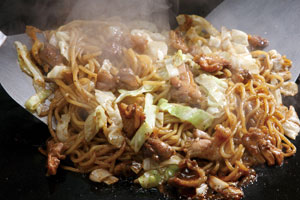
1. Hiruzen Yakisoba from Hiruzen, Okayama

Miso sauce Japanese fried noodle with chicken and lots of cabbage, which is a type of produce mainly from the Hiruzen area.
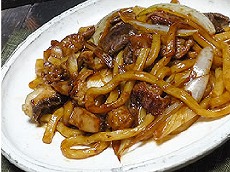

2. Tsuyama Horumon Udon from Tsuyama, Okayama

Japanese pan fried udon (thick) noodles with beef organs. Eating meat was taboo in Japan before the late 19th century; however Tsuyama was specially permitted to serve meat for medical reasons that originated the use of organs for the dish. Because of my interest in the history around the Meiji time period, and because Tsuyama is a big producer of the western scholars of the time, I have always wanted to visit there. I have searched about the area pretty often but I could not find very much about it for quite a while. But not any more. Lately, I get lots of search results talking about this dish!

3. Hachinohe Senbeijiru from Hachinohe, Aomori

Senbei (rice cracker) in clear soup with vegetables and chicken or fish. Their website says the impact this dish has on the local economy is impressive! About 536 million yen, they report. (about 7 million US dollars? I'm not good at math).


4. Namie Yakisoba from Namie, Fukushima

Japanese fried thick noodles with bean sprouts and pork. It looks a lot like the 2nd one to me...

Namie suffered badly after the tsunami and the nuclear plant incident.

5. Imabari Yakibuta Tamabomeshi from Imabari, Ehime

Fried eggs over rice with chopped Japanese style BBQ pork in the bowl. Japanese BBQ pork is not like American BBQ pork. It's similar to Chinese BBQ pork but with a soy sauce base, and usually cooked in a sauce, not grilled.

Overall, you see many pan fried noodle dishes because the event is held outdoors. Yakisoba is a traditional Japanese event food, the 3 of 5 above are a kind of yakisoba. I think that is why. Well, Japanese are big carb eaters. Atkins never crossed the Pacific, apparently!

These are the top 5 of the B-1 Grand Prix 2011. Here's another B-kyu Gourmet rankings.

In Goo (a Japanese portal site), here are highlights of the "B-kyu Gourmet Ranking: I want to try this."

1. Sasebo Burger
Local hamburger in Sasebo, Nagasaki. The US military base has a base in Sasebo; you can expect this to influence their burgers. They have quite a few original burger stands in Sasebo.

2. Hitsumabushi
Rice with chopped grilled Unagi (eel) in Nagoya, Aichi. I think this is a long time known local specialty but bit too expensive for B-kyu Gourmet. This may be an A-Class local specialty.
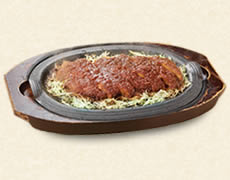
3. Miso Katsu (left photo)
Breaded fried pork cutlet with miso sauce. Also from Nagoya.

4. Tsukishima Monja
Tsukishima is a shitamachi (older residential area) in Tokyo. Monja is a thin pancake with lots stuff in it. This is monja, Tsukishima style. Why would I mention this? Because I'm an Asakusa native, another shitamachi area. Tsukishima monja is just so foreign to us!

5. Taco Rice
I've never heard of this but the description says it's taco ingredients such as shredded iceberg lettuce, tomatoes, and ground beef over rice. It is reported to be a local dish of Okinawa, but I think other areas seem to consider their original local dish as well.

6. Aizu Sauce Katsu-don.
Breaded pork cutlet over rice bowl with sauce. The "sauce" without any explanation in Japanese means a type of brown sauce, like a thicker Worcestershire sauce which we use for breaded fried foods. Katsu-don is traditional breaded pork cutlet rice bowl dish made in sweetened soy sauce with eggs but this is with a "sauce". This is from Aizu, Fukushima.

7. White Curry (left photo)
Milk based curry from Sapporo and other areas in Hokkaido. I've never heard this either but I assume it's like Thai curry with milk instead of coconut milk...

8. Sobameshi
Rice in Yakisoba. Yakisoba is Japanese style chow mein, pan fried noodle with "sauce" (please see #6 above). This fried noodle is mixed with rice. It is is a local dish of Nagata Ward of Kobe, Hyogo.

9. Toruko Rice (Turkish Rice, I think) (left photo)
Breaded pork cutlet with demi-glace sauce over curry pilaf and spaghetti Neapolitan (meaning the red sauce is already mixed with the spaghetti) from Nagasaki. I have no idea they call this Turkish.

10. Morioka Jaja-men (Zha jiang mian, a Northern Chinese noodle dish)
Hot meat sauce over noodles from Morioka, Iwate.

Here's another ranking of Jalan Gotouchi B-kyu Gourmet Grand Prix, from a travel agency Jalan's website. It is totally a different ranking. The ten in the yellow boxes are the top ten of their ranking and each links to a video.

You might notice that Japanese tend to be big on carbs! They also love breaded pork cutlets! You may not like so many carbs but lots of Americans I personally know love Yakisoba (Japanese pan fried noodle) and Tonkatsu (breaded pork cutlet). Japanese people love to arrange things with their own twists. B-kyu Gourmet is one way you can see who real Japanese are.

Wednesday, November 23, 2011

B-kyu Gourmet (Part 1) - Food Trend For a Burst Bubble

There was a time some years ago when Japan was enjoying a very good economy. They called it the bubble (バブル). During that time I was living in Japan. One evening while talking with a friend of mine, he explained to me how hard he was working to achieve a special objective: to book a top brand hotel for Christmas Eve night after a helicopter tour over Tokyo-- all for a date. (By the way, in the non-Christian nation of Japan, Christmas, especially the eve is a day for big romantic events like you'd plan for Valentine's Day. Hotel rates are far more expensive on that night.)

It seemed like it should be a big deal, but he even didn't even seem to be that in love with the girl. He worked at a job similar to one I used to have, so I pretty much knew his budget. For what reason would he want to do that? I had no idea. But obviously he was participating in what was a big trend at that time.

Another time, I went to one of those "fabulously well known" restaurants in the city with my female friend. The food was just okay but the price was not--it was ridiculously high. We paid good money for diner level service and servers with a stuck up attitude. We simply decided it was a well publicized rip off. A business taking advantage of a popular social trend.

At the same time, here in the States it was happening too! Japanese corporate businessmen, mainly in the financial field, spent tremendous amount of money every night in Japanese restaurants and bars on lavish meals and business entertaining. Yes. The wasteful trend to look and feel important was thriving inside and outside Japan.

That good economy ruined Japan, I concluded.

The good news is that what some might call the worst period of Japanese recent history was blown away when the economic bubble burst. All that marketing to encourage big spending, all the nonsense deals and rip off promotions, came to an end. The weaker economy that followed brought hard working, humble and smart Japanese back on track.

Here is a success story under the category of cuisine called "B級グルメ or B-kyu Gourmet." It is a case of reasonable good food replacing those rip off dining experiences.

B-kyu means Class B, Grade B, not the best, not of world-known class. And, people who don't care the world renown quality love it. It also means low budget. You could equate it to a low budget Hollywood B-movie. There is a similar term in Japan, actually: B-kyu eiga (B movie). B-kyu Gourmet basically means local dishes for a low budget. It is often an arrangement of a traditional dish with original twists. Lots of them use locally produced ingredients. These B Class dishes are a big trend now in Japan. Their U.S. counterparts would be, for instance, the Philly Cheesesteak, the Cincy chili dog, or New York thin crust pizza. In Japan though, there are even more varieties.

B-kyu Gourmet is may be the new catchphrase, but the food is usually quite traditional. For a long time, there have been many local, original dishes all over Japan. Take for example, ramen noodle soup. From the basic soup a city, town or region will put its own spin on it, and it becomes the original or traditional version of the soup in that place. In Tokyo, the base is soy sauce, but the base is salt and butter or miso in Hokkaido, pork bone base in Hakata, etc. Some places have a long standing reputation for such an original stamp on a dish, but the internet has introduced original arrangements elsewhere more and more. In the beginning it might have sounded weird to the people in other areas. But when they tried another region's version, they found it good.. People talked about such dishes more and more, and soon this category of food became known as B-kyu Gourmet. Some dishes have been served for a long time, some of them are just created; it depends. But now such local specialties are all over Japan. This is B-kyu Gourmet. The biggest contest festival is called B-1 Grand Prix. It has drawn over a half million visitors.

B-kyu Gourmet is now a big part of tourism and has given a boost to local economies. Because, from the visitors' point of view, they are not pricy fancy dishes. Even if they don't like it, it is still okay because they could enjoy trying something new.. From the producers' point of view, it's a low risk business venture but that can generate a big return.

Most B-kyu Gourmet do not refer to a dish in a particular restaurant. It is rather a particular dish of the local area. Most of the restaurants in the area serve the same dish. Instead of a chef of a top notch restaurant competing in an Iron Chef competition, local chefs of an area form a team and go compete in a B-kyu Gourmet contest. Therefore, a local government and tourism organization can easily tie in these events with their own promotional efforts. Because it brings visitors, the whole economy of the area also receives benefit.

Information about the food comes from individual people. If any large scale food producers or promoters try to sell an empty value, people spread the word about that right away, too. No cheaters can survive. Honest good food gets honest good reviews. The control has left the hands of impersonal large producers. Honest good businesses are creating a new, real atmosphere and people like it. It is no frills but doesn't pretend to be something it's not. It is a free and open competition to be original and serve really good food. A chef can add a new twist to the taste. A restaurant owner can make the restaurant interior charming and inviting. A manager can come up with a combination plate. Each can apply their own imagination and smartness to improve. The customers appreciate such a variety.

Also, because B-kyu Gourmet are local specialties, of course they like to use local groceries and vendors. They don't need to transport the raw materials a long distance. They do not have to use certain chemicals to preserve freshness. People can eat fresh and safe food as well.

There is the same kind of movement going in the States too. Here it is called "slow food." No more raking in absurdly high profits but no big losses either. It is the way we should be heading, shouldn't it? It is the way of the new world economy.

Well, even though you may like 20th century economy better, B-kyu Gourmet is fun to try. Anywhere you go in Japan, someone nearby will be offering their own B-kyu Gourmet. I'm not sure if Americans will like some of these dishes because Japanese are big fans of eating carbs. But just for fun, why not try some simple, innovative dishes and local dining experiences during your next visit to Japan!

I'll give you examples of B-kyu Gourmet in the next post.

Monday, November 21, 2011

Japanese 101 with Soogi's Story (1)

My name is Soogi. (English)

Boku no namae wa Soogi desu.
(Romaji)

ぼく の なまえ は すぎ です。 (hiragana)

僕の名前はスギです。 (kanji)

(Note: 僕 and 名前 are kanji, スギ is katakana, all other characters are hiragana)

Here is an explanation of these sentences:

"Boku / ぼく" = the speaker's self. The closest equivalent is "me" but it is not the objective, just a simple noun. "Watashi wa (subjective)" = I, "watashi no (possessive)" = my, "watashi wo (objective)" = me, etc. In kaji, "僕".

It basically means me or I:

Boku: used by boys.

Watashi: used by adults (unisex) and females of all ages. Atashi is used in conversation with common people, a sort of Tokyo dialect.

Ore: used by guys, a bit rough so not used in official talk. Men in conversation with friends usually say "ore".

"no / の" = particle connecting 2 nouns and makes the first noun a modifier of the second.
"Boku (me)" no "namae (name)" = my name
Boku no kuni (country) = my country
Boku no ie (house) = my house, my home, also refers to my family

"Kyo (today" no "tenki (weather)" = today weather = the weather today
"Ashita (tomorrow)" no "yoru (night)" = tomorrow night
"London" no "tomodachi (friend or friends, Japanese do not distinguish singular/plural) = London friend(s) = friend(s) in/from London
"Chicago Bears" no "54" = Chicago Bears #54 = the number 54 of the Chicago Bears. In this case, we usually don't say "Chicago no Bears". We accept the "Chicago Bears" as one proper noun, I think.

"wa / は" = particle connecting words or phrases almost like the symbol of "= (equal)"
Boku wa Soogi: me = Soogi; I'm Soogi

"Kyo" wa "getsuyobi (Monday)": today = Monday; today is Monday

"Fuyu (winter)" wa "samui": winter = cold; the winter is cold


"desu" = be/am. It makes a sentence complete but is often not included in conversations. This word is used in sentences (mostly) with the verb "be" used for nouns and adjectives. I didn't use "desu" in the story to make the sentence sound more like a boy's casual conversation.

"-masu (pronounced "mas")" is another ending which is used for sentences with regular verbs. The sense of "be" or "regular" verbs in Japanese is not exactly the same as English but most them are.

In most cases, the sentence can be understood without "desu" and it is often abbreviated or arranged in conversations. I'll talk about "-masu" later.


"Boku no namae wa Soogi desu" = My name is Soogi
The arrangement of the ending "desu".
"Boku no namae wa Soogi dayo" is how a boys speaks in conversation. If you say this to your boss in the office or to a teacher at school, you'll sound weird and childish. In such a case, use the more formal version: "watashi no namae wa Soogi desu".

"Watashi no namae wa Vanille yo!" This is a girl's way of saying "my name is Vanille". If a male said it this way, it would sound odd. In these two sentences, "dayo" and "yo" indicate the gender of the speaker. ("yo" at the end of a sentence indicates emphasis) Today it's more common for females to adopt the words boys use, but straight males still speak like guys and don't use female words or phrases.

Lesson 1:
Let's make the following sentences.

1) My dog is (a) shepherd (dog = inu, please use the word "shepherd" in English. Japanese do not use "a" "the" and singular / plural)
2) Bears' #54 is Urlacher. (#54 = 54-ban, please use English words for Bears and Urlacher)
3) Christmas is Jesus's birthday. (birthday = tanjoubi)

Lesson 2:
What do the following sentences mean?

1) Urlacher wa Bears no 54-ban desu.
2) Ashita wa kayoubi desu.
3) Serah wa Lightning no imouto desu.


Notes:
Japanese uses 3 different sets of characters (or alphabets): Hiragana, katakana and kanji.

Kanji= Chinese characters. Present mainland China uses arranged (abbreviated) forms of Chinese characters which Japanese cannot read in general. Before the Chinese started to use modern Chinese characters, and when Japanese used Chinese for writing (up to around the late 19th century), Japanese and Chinese could read the both documents. In present society, use and knowledge of kanji represents a kind of intelligence.

Hiragana = phonographic characters. All of the Japanese language can be written in hiragana but misuse and using less kanji generally indicates a lack of education. Using too many kanji characters might be a clue that someone is just showing off. Maybe academic fanatics do this.

Katakana = phonographic characters like hiragana but used mainly for foreign words. I use Soogi in katakana since this is the nickname his western friends have given to him.


1) Urlacher wa Bears no 54-ban desu.
2) Ashita wa kayoubi desu.
3) Serah wa Lightning no imouto desu.

Sunday, November 20, 2011

FINAL FANTASY XIII-2 Lost Report: Episode 4 - English Summary


The following is a translation of the narrative in this report installment.


(Episode 4)

Although the intercept at Palumpolum did not succeed, PSICOM's other group at the fallen city Nautilus captured two la’Cie’s, a girl named Vanille and Sazh Katzroy. An important source of information came from Sazh's son, Dajh. Dajh, being a la’Cie of the government, had a focus to capture Pulse la’Cie. Upon completing his focus -- to greet his father, which led to his dad's capture, Dajh was turned to crystal.

The two were detained on the airship Palamecia. They were to be sent to the capital of Eden and their execution was to be broadcasted all over Cocoon for all its citizens to see. Their captors wanted to bait the other hidden la’Cie. Because of the importance of these tactics, the leader of the Sanctum government, Galenth Dysley himself, would implement the plan from the helm of the Palamecia.

Just around that time, four including Lightning were thinking about fighting back against the government, with the air force of flying ships led by the Rear Admiral Cid Raines, a Sanctum Brigadier General in the Cavalry who did not trust the government. The Cavalry was a part of the government but did not take part in their errands. Actually the opposite. Human are not Fal’Cie's pets nor tools -- that was Raines' opinion. The government, a puppet of Fal’Cie, we intended to defeat. This had a good chance. Lightning rescuing her people would disclose the government's secret to everyone. Then Cocoon would be released from Fal’Cie's control. So, I took Lightning and her group to the Palamecia, where Sadz and Vanila were captured.

The military prepared well but the La’Cie overwhelmed them. The four of Lightning’s people could easily break the defense. They got together at the aiship base. It was unexplainable that they could come in so easily – was it only their skill and luck? There must have been a spy, they suspected. In any case, the La’Cie and Lighting’s people approached the bridge where Dysley was commanding.

Dysley was a hoax. We thought he was a puppet of fal'Cie – Eden, but he was indeed the puppeteer. He was not human. He was Cocoon fal'Cie ruler Barthandelus. A real fal'Cie ruling Cocoon! These guys, fal'Cie, think humans are just tools. They try to rule La’Cie as tools as well. According to Barthandelus, the focus of Lightning’s people is to be a monster called Ragnarok and destroy Cocoon. The leader of the Sanctum is Fal’Cie, the focus is a monster. Such an incredible story! Finally, all we could do was leave in his airship, without defeating Barthandelus.

An emergency news bulletin came to me about who got hurt at Palumpolum and receiving treatment in Eden the capital. In the sky near Eden, the flying ship Palamecia descended. It must have been caused by La’Cie. Right away I sortied on the maneuver plane and found it. I tried to attack but was unsuccessful. Their plane was just a small shuttle but moved a lot better than its expected capability. They fought well against the most advanced maneuvers. At the end of the hard battle, it looked like we got them but then an unbelievable thing happened. Suddenly, the defense shield of the capital Eden was released. It was as if the airship was invited into the capital. It flew into the city... and disappeared.

Editors' Note: The video title references FFXIII-2 but actually this report series seems to be a recap of FFXIII events and details.

Sunday, November 13, 2011

Japanese Music Video (w/English Translation): Shujinkou by Masashi Sada


Shujinkou by Masashi Sada

Tokiniwa omoide iki no gaidobukku ni makase
Sometimes, in memory of the destination, I just follow the guidebook
Anokoro to iu na no eki de orite
The station named "That Time" is where I get off and
Mukashi doori wo aruku
"Avenue of the Past" is where I go walking
Itsumo no terasu niwa mada toki no nagaori ga sukoshi
In the usual terrace, some of that time still remains a little
Metoro no eki no mae niwa rokuju-ni-ban no basu
In front of Metro Station, bus number 62
Puratanasu namiki no furui hiroba to gakusei darake no machi
The lines of platanus trees, the old plaza, and so many students all over the town
Soieba anata no fuku no moyo sae oboeteru
Speaking of that, your clothing, the patterns in it, I still remember
Anata no mabushii egao to tomodachi no waraigoe ni
In your flashing smile and a friend's laughter
Dakarete watashi wa itsudemo kanarazu kirameiteita
That so embraced me, I must have been always shining.

Aruiwa moshimo da nante anata wa kiratta kedo
Otherwise, perhaps, you didn't like a saying like that
Toki wo sakanoboru chiketto ga areba hoshiku naru toki ga aru
Sometimes, I wonder, if I could have a ticket to go back in time, would I take it
Asoko no wakaremichi de erabi naoseru naratte
At that fork, I wonder if I would choose it again
Mochiron ima no watashi wo kanashimu tsumori wa nai
Of course, I have no intention to deplore myself now
Tashika ni jibun de eranda ijou seiippai ikiru
Because it was exactly what I chose, I do my best to live with it
So de nakya anata ni totemo totemo hazukashii kara
And since you'd be so embarrassed with me if I didn't
Anata wa oshiete kureta chiisana monogatari demo
You taught me this, even if it is a simple little story
Jibun no jinsei no naka dewa daremo ga mina shujinko
In one's life, everyone has a big role to play
Tokiori omoide no naka de anata wa sasete kudasai
Once in a while in these memories, won't you please sustain me
Watashi no jinsei no naka dewa watashi ga shujinko dato
By saying I am the one playing the lead role in my life.


The setting of this song is a memory of school days in the Ochanomizu vicinity of Tokyo, which includes the JR train station. This vicinity used to have quite a few colleges and other schools around, but lots of them have moved to the suburbs. My high school was near this area, so the scenes described in this song make me miss the good old days as I recall my memories of that area.

Sada has been performing in other Asian nations, hoping this would be appreciated by his non-Japanese fans. This is his classic, and the biggest favorite among his fans.

For those of who don't know who he is, Sada is a singer-songwriter from the 70's. There was a time when he was treated as a "wuss" since his songs are so sensitive. I think that as time went by people started to recognize the simple fact that he has a real skill of using Japanese words. Not so much in this song, but he uses a lot of words we no longer use in regular conversation.

Sorry, all of my favorite Japanese music are older classics! I'm not updated at all...
If you are interested, please request a song for this voiceover + translation material. Please be aware that the song is relatively slow, though. You can probably catch the words.

Thursday, November 10, 2011

Bokeh 101

Let’s talk about bokeh. I didn’t learn about it in a classroom. It never came up when I was window shopping in Akihabara. For me, understanding came slowly, each time I browsed my favorite photos in Flickr, a website for posting photos and graphics.

Anyone with a Flickr account can take photos of a favorite subject and upload them. Almost every day, I look at these photos. This is how I visit Tokyo these days!  Most of the people I follow on Flickr are living in Japan; Flickr is my portal to Japan.  Bokeh shots happen to be my favorites.
Bokeh is a word of Japanese origin that in one word expresses the concept of using an out-of-focus area of an image to help compose the shot. The photographer can use bokeh to contrast, highlight, or offset the main subject of an image. But bokeh itself can be the main subject too. I think of bokeh as lights, but anything can be the bokeh in a shot. And, although bokeh is a Japanese word, people around the world describe their work as bokeh shots.
This term comes from the following Japanese word: boke (暈け or ボケ), which means blur” or haze”, or boke-aji (ボケ味), the blur quality.” Here is an excellent explanation of bokeh by a photographer, in more technical terms: “Bokeh characteristics may be quantified by examining the image's circle of confusion. In out-of-focus areas, each point of light becomes an image of the aperture, generally a more or less round disc. Depending how a lens is corrected for spherical aberration, the disc may be uniformly illuminated, brighter near the edge, or brighter near the center.” Navigate to the Flickr site and do a search on bokeh. Here are examples of what you will find.
Title Photo by: Eloise Claire
Photo of girl by: achew *Bokehmon*
Photo of reindeer by: Hidesax (Hidehiko Sakashita)
Photo of flowers by: mikenpo
Now, I have an assignment for you. Find a photo in Flickr that uses a bokeh element, then comment on it. Challenge! Find a Japanese photographer (such as Hidesax), and comment on the bokeh photo in Japanese.
Note: You will need to sign up for a free Flickr account to do this.
ナイスショット! ボケすご (Nice shot! The bokeh is great.)
これはいい写真です。ボケいいですね~ (This is a good photo. The bokeh is nice, isn't it.)
One of my favorite contacts on Flickr is Sakashita san, known as "Hidesax." He is a skillful photographer and an expert at taking bokeh pictures, in my opinion. He photographed this reindeer decoration....a little while ago! His caption: "Shot taken tonight in Ageo, Saitama."
For years now, I have enjoyed the photos I find in this site, especially the ones taken of Japan. I add my comments all the time, to say nice job, or thank you for uploading this. Usually much thought is put into composing a photo using bokeh.
A nice comment might make the photographer feel pleased to know people like the work they share. I hope everyone reading this will think about sending a such message of appreciation, too. Please try it!

Tuesday, November 8, 2011

Edamame Two Ways: Casual Style and All Dressed Up

Edamame, or soybeans, might be considered the #1 favorite snack in all of Japan. In their natural fresh state, a green pod hides two or three beans inside. In Japan you can always find edamame for sales at the supermarket fresh (when they are in season during the summer). It is rare to find them for sale fresh in the U.S. though; you'll probably need to search for them in the frozen food aisle. To ensure that the edamame are non-GMO (non- genetically modified), get the organic type. Once you've found your edamame, there are many ways to enjoy them. Here are two recipes: Casual and Fancy Style.

Casual -- Edamame in Shell for Two (home style / izakaya style)
Recipe:
1) Take 12 to 16 ounces of edamame in shell, fresh if possible (frozen if necessary)
2) Place in pot of boiling, salted water.
3) Let them cook at a full boil for about 7 - 10 minutes
4) Strain and place in a large bowl.
5) Add more salt if desired.
6) Get an extra bowl for discarding the shells.
7) Serve very chilled beer.
8) Serve edamame hot.
Enjoy easing the beans out of the steaming hot pods, eating them and discarding shell. Chase down with cold beer. Delicious! (Steps to prepare and serve by Lily.)

Fancy -- Edamame Salad with Shiso and Meyer Lemon Vinaigrette

3 cups shelled e
damame (about 12 ounces)
2 Meyer lemon
s or regular lemons.
5 shiso leaves, s
liced
2 tablespoons fruity extra virgin olive oil
2 tablespoons rice vinegar
2 tablespoons maple syrup
Kosher salt to taste
Freshly ground black pepper to taste

Cook the edamame according to the package's instructions (the frozen kind are typically boiled for about 5 to 10 minutes). Drain, place in a serving bowl, and let cool to room temperature. Zest one lemon and set aside. Squeeze the juice from the lemon (about 1 tablespoon plus 1 teaspoon). In a blender, add the lemon juice and zest, half the shiso leaves, the olive oil, vinegar, and maple syrup. Add the salt and pepper to taste. Blend well and gently mix the dressing with the edamame. Toss with the remaining shiso. Zest the other lemon and sprinkle the zest on top. Serves 4.

Sake pairing suggestions: Ichinokura Himezen Junmai, Dewaza Kura Dewasansan Junmai Ginio, Hoyo Kura No Hana Junmai Dai Ginio.

Shiso gives an interesting taste to this dish. You are likely to find fresh shiso at an Asian supermarket or grocery store with a well stocked produce section. If you can't obtain it, enjoy the salad without it.

Recipe by Eric Gower, author of "The Breakaway Japanese Kitchen: Inspired New Tastes." His cookbook is available for purchase here.