Saturday, November 5, 2011

A Visit to Fuji-Hakone Guest House and Onsen

Several years ago, I lived in Tokyo and worked for a Japanese company. My job required speaking and listening to Japanese Monday through Friday for ten hours a day and sometimes longer. It was challenging every day and the best job I've ever had. Outside of work, free time was spent going to city events, shopping, or dining with Japanese friends. We would speak a blend of English and Japanese and I enjoyed every minute.

Sometimes, though, I needed a mental break, a brief, English-only oasis. Those were the times to reach out to my Western friends in FEW, or Foreign Executive Women. FEW gave me the opportunity to interact with people from around the world who were like me, a Westerner living in Japan. Each month about 30 or 40 members met in Yurakucho to munch on appetizers, listen to a guest speaker, and network with other members and guests. We spoke English for three marvelous hours! I liked FEW so much I became a board member and got involved in planning several official group activities for the membership.

Once seven of us decided to clea
r our schedules and take part in an unofficial activity not planned by FEW but rather by ourselves, a few good international friends. Our idea was to go on a weekend trip to a hot spring (温泉, onsen) in Hakone (箱根), southwest of Tokyo, at the foot of Mt. Fuji.We knew Japanese people really liked taking short trips to a hot spring town (温泉町, onsen machi); we wanted to try it. Interested in keeping our expenses down, we made a list of what was important to us.


Our group’s criteria:
-- Place that would be an easy commute to / from Tokyo (couple of hours)
-- Two-night basic accommodation, luxury rooms not necessary
-- Inside, smaller hot spring acceptable
-- No fancy meals purchased at the accommodation
-- Meeting or break room that we could use for relaxing and talking together
-- Walking paths and mountain trails for taking a hike or nature walk
-- No interest in arcades, karaoke, bowling, or other typical amusements
-- English not necessary; some of us spoke Japanese
-- Quiet place, no crowds, with a "retreat" type of atmosphere
-- Train access not necessary; we had cars for transportation

It was worth it to do research online before making a reservation. We compared lots of accommodation options, and found several that met our criteria and budget. We decided to book a no-frills standard Japanese inn (旅館, ryokan) in Hakone called Fuji-Hakone Guest House. This place was perfect for our getaway.

We took two cars to travel to the inn, located in the resort town of Sengokuhara, in Hakone National Park.Arriving right around dinner time, we checked in, then walked along the main street into town and ate at a small restaurant. Returning to the inn, we took a look around. Accommodations were traditional tatami style rooms with no private bathroom. For the record, that's not typical for most Japanese inns and hotels. Guests do get their own bathroom! But this layout was similar to a college dormitory. We had to walk down the hall to access a communal bathroom. We located the break room, then the hot spring and bathing area. This inn offered indoor hot springs for women and for men (separate gender only), open 24 hours a day, and I believe some outdoor hot springs too.

The next morning we walked down the street to a café / bakery for breakfast. Then we set out hiking on trails and exploring the national park. We picked another casual place for lunch, then strolled around town. The time of year was early fall. The air was warm but less humid; the air was clean and crisp. We took in the natural beauty of Hakone, and even explored several other properties clustered around the vicinity, in case a return trip was needed.

By late afternoon, it was time for the hot spring. Of the seven of us, two women were from Germany (they both spoke great English, and one was fluent in Japanese too), one was from France, three of us were from America, and one was from Canada. Only three headed to the baths--myself, one of the Germans and the Frenchwoman. The others said they didn’t have an interest to go, and opted to do something else instead. I was a little surprised at the time, but later realized that an interest in this kind of thing partly depends on cultural background.

In some cultures bathing (or swimming) in the nude around others is a no big deal and a part of life; in others, it's not a usual practice, so most will be too self-conscious to try it. Americans pretty much fall in the second group. I never did such a thing before, well not since age 3 or 4, when I splashed with siblings in a bathtub at home. We needed and got our bathing “privacy” by age 5! I would estimate that a large percentage of my American friends would be hesitant to enter a hot spring or public bath on their own, for these reasons: 1) due to shyness or modesty, 2) an idea it's strange to do this, 3) the language barrier and 4) not knowing what to do in such a place. (I know well—such an American used to be me) But! I also know many Americans are adventurous and like to take a risk. I’m certain some American people would go and try out a hot spring experience—and love it—especially if someone showed them what to do.

The three of us who entered the hot spring didn’t know what to do either, but we were fearless! We watched what other bathers were doing and did the same. (Put all stuff including clothes in a locker, enter the facility, take a sitting shower, wash and rinse off, then ease into the bath and soak away in steamy hot spring water up to your chin!) The mineral water was fantastic. I didn’t tell anyone until later, but for a minute after exiting I was so dizzy I almost fainted. My face was bright red! In the changing room I slipped back into a cool cotton t shirt and jeans and began to feel much better, amazing in fact!

As we joined our group and headed out for a beer, then dinner, I felt relaxed and quite rejuvenated. That natural high lasted right into Sunday as we returned to the city. Hot springs may not be for everyone, but for me they go far beyond a basic bath or jacuzzi experience. It may be the highest benefit comes from the whole ritual of going to a hot spring. Whether going as a couple, with some friends, or as part a large group - it's all about slowing down, cleaning up, eating well, and recharging as a individual - with others. For more information about this property or about the inns and hot springs in the Hakone area, click here.

See Related Post: Rating and Review: Fuji-Hakone Guest House, Hakone, Japan

Rating and Review: Fuji-Hakone Guest House, Hakone, Japan


Fuji-Hakone Guest House in Hakone, Japan


Rating
:

Location (4 / 5 )
Food / Amenities (2.5 / 5 )
Hot spring (3 / 5 )
English Info / English-Speaking Staff (4 / 5 )
Overall: (3.5 / 5 )

Review:

TheFuji-Hakone Guest House is located in the vicinity of Hakone, in the hot springs town of Sengokuhara, not far from majestic Mt. Fuji. It is a quick two hour or so trip from Tokyo by car, bus, or train. Hakone National Park is within walking distance of this property, where you can walk on mountain trails and nature paths. It is among a cluster of many other inns and hotels, each with their own attractions and hot springs. This property is located along a quieter section of the town's main street.

It is a basic accommodation without many of the extra services and amenities of more traditional or more modern style inns (that come with additional charges on top of higher room rates). The building has a plain exterior; there's no grand entrance or valet parking. It looks more like a small lodge than a ryokan (Japanese inn). Rooms are in the traditional tatami mat style, with no bathroom or toilet in the room. Such facilities are shared in a separate room down the hall. Smoking and non-smoking rooms are available for booking. They have internet access, though no computer on the premises. There was a small, undecorated sitting lounge, and a nondescript dining area for breakfast. If you want breakfast, you need to request the breakfast plan. They do serve a Western breakfast (eggs, toast, maybe a meat side and coffee or tea), as well as a Japanese breakfast. If you do not choose the breakfast plan, it's a short walk down the street to get coffee and something to eat at the nearby restaurants, cafes or convenience store. This is a facility that does not have in-room set up of any meals, which is not typical for ryokan. I love those meals, they are beautiful and delicious, and I do recommend that you book a reservation at a true traditional ryokan sometime to experience that.

You have several options for enjoying hot springs at the Fuji-Hakone Guest House. They have indoor baths open 24 hours a day, for men and for women, separate gender only. There are outdoor baths as well. I had a wonderful experience in the indoor hot spring. The water was very hot and didn't have the strong smell you get with some mineral spring compositions. It was not crowded at all, which appealed to me very much. I noticed that hot spring baths are the only type offered at this inn--there is no facility for public bathing (without the hot spring water).

Be aware that a "shared" hot spring as it is described in some print and online brochures means it is for use by all of the guests, as opposed to a hot spring bath that is in your own room and private. Unless otherwise stated, you can expect to share the bath only with your gender.

This simple property has pleasant surroundings and a quiet retreat feel to it. With no crowds and little noise, it was an easy place to relax and unwind with friends. Years ago when I visited, no one there spoke English. This was true for many small hotels and inns around Japan at the time. Now, though, things have changed. According to the a listing for this accommodation on the Internet, English-speaking staff are employed to welcome Western visitors and make them feel at home. This budget-friendly accommodation gets high marks for the friendly staff. Cost per night for a room averages about 8,000 to 9,000 yen per night.

Address and contact information:
912 Sengokuhara Hakone-machi
Ashigarashimo-gun, Kanagawa-ken
+1-248-325-6636 (US)
072-756-6242 (Japan)
9:00 AM to 5:00 PM, JST


This property is accessible by car and by train. From JR Tokyo station, take the JR Tokaido Shinkansen to JR Odawara train station. This train ride takes about 40 minutes. Another route is from Shinjuku station in Tokyo. Take the Odakyu train line to the Odawara train station. That trip takes about 70 minutes.For more information about this property or about the inns and hot springs in the Hakone area, click here.

Here is a link to a downloadable PDF with information on buses to the Hakone area:
http://www.odakyu-hakonehighway.co.jp/common/pdf/english.pdf

See Related Post:
"A Visit to Fuji-Hakone Guest House and Onsen"

Friday, November 4, 2011

Japanese Bath Culture (4) ~ Spa

Other Types of Public Bath Houses: Kenko Land / Spa

You will find other types of public bath houses that fall somewhere between Sento and Onsen.

In the way some Onsen facilities have expanded their size and attractions, non-onsen bath houses have tried to do that as well. If the bath house making such improvements is a government-authorized Sento, it will call itself a Super Sento. That simply means a bigger Sento. Those that cannot call

Japanese Bath Culture (3) ~ Onsen

The Onsen, a Japanese Favorite Destination
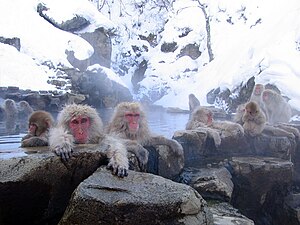
Nihon Monkeys enjoy Onsen

Onsen means hot spring. It is best known for bathing or soaking in mineral hot water, and it's another whole culture. This is undoubtedly a favorite trip destination for Japanese, and that includes all sorts of amusements that come along with it.

If the water is not either a hot spring or heated spring water, it can't be called Onsen. Onsen refers to the type of water they use, it doesn't mean the service or the type of facility. For a long time

Thursday, November 3, 2011

Japanese Bath Culture (2) ~ Sento

Sento: Public Bath House for Everyday Use

For people in the city who live in tiny apartments without a private bath, we have public bath houses called Sento. Sento is made of two kanji characters, "Sen 銭" meaning fee and "To 湯 (tou) meaning hot water. This is a basic type of bathing facility open to the public. Sento bath houses are generally for city residents for everyday use, and are run by the municipal government.

Edo, a capital city of the Edo period (1603~1868), what is presently central Tokyo, had a series of big fires which were often caused by heating of bath water. It is said that because

Sunday, October 30, 2011

Taiko Drumming Group Shines at JapanFest

The JapanFest event took place in Atlanta, Georgia on Sept. 17-18. It's an annual event that attracts thousands and showcases Japanese culture, talent, and commerce in the southeastern U.S.

Job one: to get a good seat for the afternoon taiko performance. I knew it would be great. The group that performed is called Matsuriza. They flew in from Japan to play for us.

Approaching a nice stranger sitting near me who held poised and ready a very large professional camera, I asked if he would send to me his digital photos from this performance, explaining that I wanted to make a slideshow and upload it to YT. Actually, there was a lot of smiling and begging on my part for this favor. The photographer, Ben Ennis, kindly agreed! This is one of his photos. Today I finally completed the video slideshow. You can watch it here.

Tuesday, October 25, 2011

Ordering up Culture, Izakaya Style

An uniquely Japanese tradition, the izakaya is is a favorite evening meeting place and hangout for salary men and women, working girls, locals and school buddies.

An izakaya (居酒屋) is a Japanese drinking establishment or pub that also serves food to accompany the drinks. They are popular places for after-work drinks and casual dinner parties in a lively atmosphere.

Most izakayas have a red lantern hanging near their doorway, making them easily identifiable. Izakayas are often called akachōchin ("red lantern") after the red paper lanterns that are traditionally displayed outside. This usually refers to smaller places not affiliated with a chain.

Depending on the izakaya, customers sit on tatami mats and dine from low tables in the traditional Japanese style, or sit on chairs and drink/dine from tables. Many izakaya offer a choice of both, as well as seating by the bar.

Once you are seated you will be be given an oshibori (wet towel) for cleaning your hands. Then your server will bring an otōshi or tsukidashi (a small appetizer) for each person. This is local custom and usually charged onto the bill instead of an entry fee. Japanese people in Kantō region (Tokyo vicinity) call it otōshi and people in Kansai (Osaka vicinity) call it tsukidashi.

The menu may be on the table, or displayed on walls. Picture menus are great! They are common in larger izakaya. Food and drink can be ordered as often as you like. They are brought to the table, and the bill is added up at the end of your meal. Unlike other Japanese styles of eating, food items are usually shared by everyone at the table.

Izakaya were traditionally down-to-earth places where men drank sake and beer after work. You can still find them, but the now they are complemented by a growing population of groups of women and students. Izakaya today cater to a quite a range of clientele – including hungry and thirsty foreigners. So ask for an English menu if you don’t see one. More places have them now.

Izakaya come in all varieties. Chain izakaya became popular in the ’80s, and continue to draw patrons today. Tengu is an example of a chain. It is large, noisy and crowded, with lots of eating and drinking choices. Places like this start at a medium hum and get progressively louder and more rowdy as the night goes on. Chain izakaya often offer some dining options known as nomihodai ("all you can drink") and tabehodai ("all you can eat"). For a set price per person, customers can continue ordering as much food and / or drink as they wish, with a usual time limit of two or three hours.

Some izakaya are known for a certain food. Yakitori-ya specialize in yakitori (grilled meat on a stick). The skewers are often grilled in front of customers. Others are known for their intimate ambiance and tight space. Those humble pubs may have a seating capacity of ten!

Izakaya food is usually served in appetizer-sized portions. Many items are designed to be shared. What might be on the menu?

  • Yakitori - grilled chicken on a skewer
  • Kushiyaki - grilled meat or vegetable skewers
  • Sashimi - slices of raw fish
  • Karaage - bite-sized fried chicken
  • Croquette – medallion of creamy mashed potato inside, crunchy fried coating outside
  • Bacon Aspara – Asparagus spears wrapped in bacon
  • Edamame - boiled and salted soybean pods
  • Tofu
    • Hiyayakko - chilled silken tofu with toppings
    • Agedashi tofu - deep fried tofu in broth
  • Tsukemono - pickles
Izakaya drink choices depend on the establishment, but the usual selections include draft beer, sake, shochu. Drinks are reasonably priced, and remember, no tipping.

The izakaya is uniquely Japanese tradition, and one of the best ways to become submerged in the culture and even meet a few locals. Going to an izakaya can be the best experience ever. Let the warm and friendly folks there be your welcoming committee!