Sunday, March 25, 2012

Relax Body and Mind in an Asian-Style Spa and Sauna

Have you ever heard of King Spa and Sauna? If you have, that's good. If you've been to one, that's great! This overview is for the uninformed. A personal review follows in a separate blog post.

King Spa and Sauna is a Korean style bath, spa and sauna with two locations in the US:

-- Niles, IL, a northern Chicago suburb
-- Dallas, TX


A number of Korean saunas are also located in the Los Angeles area.

This post will focus on the Niles location. It's in a typical suburban strip mall. H Mart, a big Korean super market, is right next to it.

When you walk in the front door, you will come to the front reception desk. You pay a $25 entrance fee here, and receive a locker key attached to a plastic bracelet. From here, men go the left and women go the right, each to their respective locker room.

Once you enter the hallway leading to the locker room for your gender, you'll take off your shoes and place them into a small shoe locker labeled with a number that matches the number on your bracelet.

Enter the locker room. If you would like to have a special service such as a body scrub or a massage, look for the computer reservation station. A clerk is usually standing there waiting to assist. You tell the clerk which service you want. They will fit you into the schedule, telling you a start time. It is usually within an hour, or even half an hour. The photo a the left doesn't show it but there is rack with folded cotton "uniforms" - a set of shirt and short pants. You wear them in the co-ed area.

At this point, you're in the locker room, and it's time to make a choice. Wet private baths and sauna (with others of your gender only) or dry public sauna - the facilities where men and women share in the amenities. If you are ready to experience public baths the Asian way, these are your next steps:

1) Take all clothes off and put them in the locker labeled with the same number on your bracelet. The key on your bracelet will lock up your belongings. Once naked, proceed through the double glass doors into the bath area. It has two big hot bath tubs, one water tub, one steam sauna, shower areas and the areas for sitting and washing.

In this area there are bays where an attendant receives you (by appointment) and will give the full body scrub service. It is basically full body exfoliation. Words can hardly describe it! Afterward, your skin never felt so clean and smooth! It may seem odd but nothing can substitute for this amazing experience. That service and all the rest are optional. You don't have to get any of those services. If you wish, you can take a long shower, soak in the baths, and enjoy the wet steam sauna.

Once you're done with that part of the facility, come back into the locker room.

2) Put on your "uniform" of shirt and short pants, and follow the signs that will lead you to the dry sauna area. In the center of the room is a big lounge area, many tables and chairs in the middle. A number of sauna rooms with a variety of themes are lined up on the both sides. At the far end, there is a food counter and place to pour yourself a cup of cold water. At this always open station you can drink all the cold water you wish. You can order food and soft drinks, sit in the area and eat/drink.

The lounge area is pictured at the left.

Food Court (menu)

What are the dry sauna rooms about? You can't miss them! They are small to medium-sized compartmentalized rooms, each decorated in a different theme, some quite elaborately.

One of the characteristics of each dry sauna room is the heated floor. Most people lie down, face side up. The floors heat apply a direct heat to the whole body, easing body aches from tension. Towels are okay to lie on for more indirect heat from the floor.

Inside each dry sauna room, you are expected to be silent. Talking and conversation is not allowed. Do that in the large lounge area. The dry sauna rooms are usually decorated with crystals and/or other stones or natural materials. Enter and exit the rooms whenever you like, as many times as you like within a 24 hour period. (Yes, this facility is open 24/7)

Here is a list of the dry sauna rooms:

Fire Sudatorium: Very high temperature, they give you a blanket to cover your body.

Pyramid Room: Shaped like pyramid

Salt Room: salt

Ice Room: ice

Bul Ga Ma: a big tatami matted room

Charcoal Room: charcoal

Amethyst Room: amethyst

Base Rock Room: ($5 surcharge) It's pretty popular in Japan too, called ganban-yoku (rock plated bathing). You pay the surcharge at the door, borrow a sheet and take 15-20 minutes laying on the rock plate. The rock plate is pretty hot, you put the sheet and the wood pillow to lay on. It has a clock inside to see the time. Lots of Japanese places have a sand clock by each section. The $5 covers a whole visit, you can come back to this room as many times as you like.

Upstairs relaxing sections:
1) Reclining seats and big TV screens usually showing US TV shows or sports.
2) Quiet room for each gender: men and women each get a tatami matted room, low heated, a big TV screen usually shows Korean TV shows.

Also on the main floor:
A full screen movie theater usually playing a popular Western movie. The seating: full size recliners!

There are also rooms just off the main lounge area for pressure point massage and foot massage services.

Here's an idea I just want to put out there. To the managers of old water parks and back-in-the-day resort hotels in the U.S.: Why don't you look into upgrading your facilities to the style of the Asian Spa and Sauna?

WiFi Vending Machines Go Wireless

Japan is a vending machine paradise. Here is the kanji for vending machine: 自販機 ("jihanki", the abbreviation of "jido hanbai-ki" 自動販売機 meaning automatic selling machine). Everywhere you go, you find a vending machine of some kind within walking distance.

The most popular ones are for soft drinks, as you can see in the video clip above. The one he chose, Pocari Sweat, is similar to Gatorade. It's a pretty strange name but most products in Japan are like that - when spelled alphabetically, the name just comes out weird. That's very common in any foreign culture, I think. And it applies in reverse too. Some names of American products brought into the Japanese market may have names that sound funny to them as well.

Soft drinks and cigarettes are very common in vending machines in Japan, but there are so many other types of products for sale in these machines too. In busy train stations in Japan you'll see people lining up at ticket vending machines, which gives me great confusion every time I go there even though I completely understand Japanese.

I saw a television program featuring cook and traveler Anthony Bourdaine buying fried chicken from a vending machine. He opened the package and said, "warm... soggy". They have coffee brewing vending machines like in the video above, cups of noodles (you can get hot water from the vending machine), and snacks. If a commodity can be sold over a counter, you can probably also buy it from a Japanese vending machine.

Most of these machines take both coins and bills, a lot of them are also equipped to handle transactions by keitai (cell phone). If you have the right kind of cell phone and contract, you can buy a drink by touching your phone to the panel. This kind of cell phone is called "osaifu keitai お財布携帯 (wallet cell phone)". Also, prepaid cards like Suica (prepaid rechargeable train card, we'll talk about it later in a train post) can be used.

Vending machines offer not only convenience - their usefulness goes beyond that. The one pictured at the left is a new kind. The kanji is 災害対策用自販機 (saigai taisaku-yo jihanki) and it means vending machine in case of an emergency. These vending machines will release the drinks for free in emergency situations like natural disasters. They came into use after the 3.11 earthquake and tsunami in 2011.

Also, most vending machines like this have a sticker stating the address. It started in 2005 for people who need to know what the exact address is for that location in case they have to call the police, fire department or an ambulance for help.

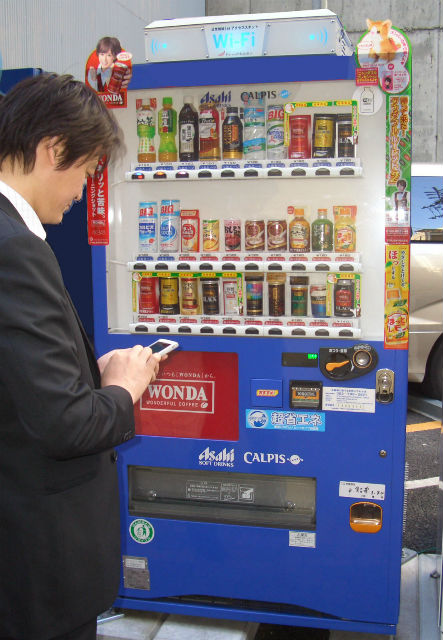
Now, here is the newest machine with a high tech feature: free WiFi! This vending machine has a built-in WiFi router.

Asahi Calpis Beverage Co., Ltd. (by the way the guy in the first video didn't know Calpis, a long time Japanese favorite yogurt-like drink) has announced they will install 1,000 WiFi vending machines in 2012, mostly in the big cities like Tokyo, Osaka, Nagoya, Fukuoka and Sendai to start, and 10,000 more in next 5 years. Such a vending machine will generate a WiFi signal within a 50-meter radius. A customer can use it for 30 minutes maximum (it cuts the connection after 30 minutes - you have to access it again after the 30-minute time period).

This is another confusing thing - why has no one yet solved the issue of how to provide free WiFi in Japan. At least such vending machines are a positive step in addressing this dilemma. So far, I have only seen news releases about these machines from the distributor - no comments from actual users yet. We'll tell you more about this when we actually hear from first hand users who experience this new convenience.

Saturday, March 24, 2012

The Melancholy of Haruhi Suzumiya – Anime Review

Do you have some vacation days or free evenings coming? Maybe you’re in the mood for a different kind of story. One that is based on imagination and science fiction, with characters who say insightful or philosophical things one minute, and get themselves into intense or silly situations the next. Whether you've watched anime before or this is your first, I'd like to recommend what has become a high profile sensation in present day Japanese culture: The Melancholy of Haruhi Suzumiya.” It's entertaining, funny at times, full of twists and turns. It will draw you in and get you thinking.

This story takes place at a high school in a modern day metropolitan area and focuses on a girl named Haruhi Suzumiya. She has the power to change reality and anything about the world that she wants to just by applying her will. The thing is, she doesn't know she possesses these powers and thinks she is normal. Haruhi is outgoing and fearless most of the time. She gets into moods too, bored one minute, bright and bursting with energy the next.

The story is told through the point of view of Haruhi’s friend, Kyon. Kyon joins the high school club that Haruhi creates, the SOS Brigade Club, after meeting Haruhi in class one day and suggesting it to her. He is a shy, likeable guy with a sense of humor and a flair for sarcasm. He is also fascinated by Haruhi and over time seems to be developing feelings for her.

Haruhi is bored with the world and wishes that she could meet aliens, time travelers and espers - people with psychic abilities. The whole point of the club is to attract people with these strange and amazing abilities, and then seek out other mysteries of the world.

Soon three other "students" join
Haruhi and Kyon in the SOS Brigade. The twist? Each of them secretly has one of the attributes Haruhi is interested in. There is the perceptive, quiet, highly intelligent alien, Yuki Nagato, the psychic Itsuki Koizumi, and the time traveler Mikuru Asahina. These five become close friends, but at the same time the three all want something with Haruhi. Nagato wants to observe and find out how Haruhi gets her power to manipulate reality. Itsuki wants Haruhi to never find out that she has the power she has, because it could potentially mean the end of the world. And Mikuru the time traveler wants to find out why people from the future can’t travel back in time earlier than three years from the present.

Be prepared to take a trip down a rabbit hole with this story! There’s lots going on that will have you replaying scenes just to take another look and catch subtle words, looks, and camera angles that convey meaning and highlight sophisticated storyline details. Here are some viewers’ comments that I found in an online forum:

“The meaning behind all this? Someone said that the real world was the world of ideas because it will not fade or collapse, unlike the physical world. Physical structures of things will be destroyed in a matter of time.

“'Maybe this is the revival of a super weapon created by an ancient race'…I'm beginning to notice that me and Haruhi have very similar imaginations...”

What if we're all as powerful as Haruhi is, and we just aren't fully aware of it yet?

“Yuki is supposed to be emotionless and logical. Still, sometimes it looks like she is kind of attracted to Kyon, but that's just a guess. She is obviously loyal to him and respects him.”

Watch how the story unfolds and develop your own questions or conclusions! This anime is available for purchase on DVD at Best Buy or online. You can also watch "Haruhi" on the Internet, for free or for a fee, depending where you go. This series is available to watch two ways depending on the service provider or DVD: Japanese language with English subtitles, and dubbed in English. I would guess the DVD offers both versions. Crunchyroll, the site I used to watch this series, offers English subtitles. I was glad for that, as I like the work of Japanese voice actors - especially in "Haruhi."

Crunchyroll This is the easiest way to watch this anime. Sign up for a free account, and watch all episodes in the correct order without any fee. Or, you have the option to pay a monthly fee to watch this and all kinds of Japanese anime and movies in a higher resolution and free of commercial banners.

YouTube The problem with watching on YT is that for some reason all the episodes are numbered differently and you will end up watching the episodes out of sequence. If YT is still your first choice, find an online wiki or forum to get a list for viewing episodes in the correct order. I believe Hulu, Netflix and other services also make this anime available.

Haruhi Suzumiya” was originally a series of light novels written by Nagaru Tanigawa. It was adapted into an anime production that aired in Japan in 2006. The voice of Haruhi is performed by popular Japanese singer and voice actor Aya Hirano.

In the cosplay world, many are inspired to recreate the SOS Brigade club members. Search the Internet and you can find lots more cosplayers who dress up in the characters of Haruhi, Nagato, and Mikuru (shown at left), Kyon and Itsuki.

Popular songs also spinned off of the series. The 2006 anime has two opening themes: "The Mikuru Legend of Love" (恋のミクル伝説 "Koi no Mikuru Densetsu"), performed by Yuko Goto and used as the opening of episode one (sometimes called episode zero), and "It's an Adventure, Right? Right?" (冒険でしょでしょ? "Bōken Desho Desho?") performed by Aya Hirano and used in episodes two through fourteen. The main ending theme of the series was "Sunny Sunny Happiness" (ハレ晴レユカイ "Hare Hare Yukai") performed by Aya Hirano, Minori Chihara (singer and voice actor of Nagato) and Yuko Goto (voice actor of Mikuru). This last song has a set of dance moves to go along with it.

Select is a music video with English subtitles sung by Minori Chihara. It's about the character she plays, Yuki Nagato. This is a really nice song by a talented singer.

My blog partner has pointed out something that might be really interesting to Haruhi fans - an entire website with video clips, maps and photos that show where in the city various scenes took place. Fans can plot out a Haruhi Pilgrimage ("Suzumiya Haruhi no seichi junrei") and go visit the actual places where the scenes happened. The site is here. It is in Japanese only. Below are two links embedded in the website to give you an idea of what the video clips look like.

Video clip example 1: Scenes from "Haruhi"

Video clip example 2: Scenes from "Haruhi"

I like this website! Another well done Haruhi Pilgrimage video clip on You Tube that also takes animated scenes and transforms the image to the actual place is right here.

Here are some areas to do some research if you’d like to read more:

Basic Overview Wiki

Advanced Wiki - You just might have Haruhi questions! This site will help answer them but there are spoilers, so save this for after you have watched all the episodes.

Before a year or two ago, I never watched anime because it seemed they were for kids, teens and 20-something audiences. That's not true at all, though. In Japan, there are anime for every age group, covering all kinds of topics and genres.

"Haruhi" surprised me in a good way. With its clever writing, engaging characters, fanciful animation, and thought-provoking storyline, this sci-fi series is right up there with some of the great “X Files” episodes! Because of "Haruhi", my first anime, I developed an appreciation for these kinds of productions and now look for others to add to my Must Watch list.

Monday, March 5, 2012

Machi-con: Local Events Bringing Singles Together

Conpa (konpa in romaji but I'm typing it with a "c"since it makes a bit better sense in English) is an abbreviation of "company" which means relaxed informal drinking parties (Japanese love formal drinking parties as well but that's another story). The term is actually decades old. It means basically gathering for an informal get together. It's pretty close to the American term "having company over" except that the guests meet at a restaurant or bar instead of coming over to someone's home.

As time passed, the shorter abbreviation of "-con" came to mean the "conpa" as a suffix. There used to be other -con words but presently "Gou-con 合コン" (Gou is from "合同 goudou = consolidated, together, implying co-ed" and "conpa") is the most commonly used word; it translates as young singles' co-ed drinking parties.

It's arranged this way. Party organizers call up a number of males and females and invite them to meet for the drinking party. In Japan, these parties take place in Izakayas or restaurants, not in someone's house or apartment since most Japanese rooms are way too small for hosting parties.

These invited guests are usually 20-something and college kids, but Gou-con co-ed drinking parties are arranged for other age groups, too. Another word for informal drinking parties would be "nomikai 飲み会" ; this word is usually used when the party is formed for people who already know each other.

Like parties everywhere, both Gou-con and Nomikai offer opportunities to find a date. Gou-con parties are oriented more to find a date than Nomikai get togethers. In the latter, relationships among the participants are likely to have already been settled.

In Japan traditionally, arranged marriages used to be common and private meeting setups were called "Omiai お見合い". But EEOC dictates and a somewhat questioning attitude from the West about this tradition eventually changed such a practice. Now Omiai arranged by the family or personal acquaintances of the parents are no longer popular. But in fact, studies show that a high percentage of Japanese people in their 20's~30's are single; poor luck or lack of opportunity to meet the opposite gender are often blamed. People having available sources could participate the Gou-con through their friends but many people don't have such connections.

So now enter Public Omiai parties, renamed with the -con suffix to represent the idea being updated, and coupled with a promotion of the local businesses, called "Machi-con (Machi means town)". This translates as town-size company-finding parties.

In these Machi-cons, the local government or community or the government can be the promoter but often they all are tied up and sell the tickets to the general public or a limited public. Event promoters team up with the local restaurants and other businesses. The style varies but commonly the participants buy a ticket and visit freely a number of participating restaurants in the area for a limited time. Other businesses get involved by issuing coupons for special services offered during the event. Participants have opportunities to meet people while visiting those participants restaurants here and there, and enjoying their food and drinks. Japanese love festivals involving food; this is another kind of food festival with local business promotions targeting the dating community. Each event often has a name with the whole or part of the city's name for the prefix and the -con for the suffix, such as Hama-con (Yoko"hama") and Shibu-con ("Shibu"ya).

An example of a popular Machi-con event is Chiba-con, held in Chiba City, of Chiba Prefecture. The number of tickets sold total 300, 150 of each gender. The ticket cost is 5,900 yen for male guests and 3.900 yen for female guests. The registration is somewhere around the Chiba station. Guests wear a wrist band to enter the participating restaurants/izakayas which are open to participants only during the event hours (15:00~18:00 on a Sunday). Food served is buffet style, drinks are either free for fixed choices or available for a discounted price. I guess the free drinks may be soft drinks since it's a day time event but I'm not sure. This event says it is not only for singles looking for a date.

These events seem popular because participants don't have to appear too eager for finding a date. They easily can leave any situation and just say "well, I wanna try another restaurant". Everyone is made to feel more safe and relaxed, no pressure. Local businesses benefit too; they get a good opportunity of promote what they sell. Some areas involve local tourism as well; other attractions and events besides restaurants can be tied into the main event.

Such events may not be perfect but overall the idea works well. Some events have attracted thousands of participants. People can get together for food, drinks, fun, and good company, plus the local economy gets a boost. Not a bad idea, is it?!

Friday, February 24, 2012

Hina Matsuri 雛祭り - Girls' Holiday (March 3)

March 3rd in Japan is the holiday for girls called 雛祭り or Hina-matsuri. It is also one of the seasonal holidays for the peach blossom since peach flowers blossom around the same date in the lunar calendar.

Since classic Japan is not EEOC, this girls' holiday is not a national holiday while the boys' holiday, May 5, is. It is called こどもの日 "Kodomo no hi", or Children's Holiday in current Japan, so it is officially non-gender but it is traditionally the holiday for boys.

Please check Wikipedia for extra details about Hina-matsuri if you're interested; here is an overview. The girls' holiday Hina-matsuri is the day for the Hina dolls decoration. Hina (hiina) is an archaic name of dolls in Japanese and the holiday for Hina became Hina-matsuri. Based on local tradition, the holiday involves a special set of dolls. This decorative display came to be called "Hina-ningyo (ningyo means dolls)".

The Hina-ningyo doll set is quite a common gift for a baby girls' first March 3. The most common set is a 7-step display as shown above. A red carpet covers the 7 staircase-like platforms and the dolls are placed on each step-like platform in a certain order. This represents a wedding of Emperor (not sure which Emperor). The one my sister and I had for some reason had a description saying it was Emperor Tenchi (from the 8th century) but it is more common to be an anonymous emperor in the Heian era (8-12th century).

The order of the dolls are as follows:

The top level: the Emperor (O-dairi-sama) and Empress (O-hina-sama). Actually the "dairi" means the couple of Emperor and Empress but currently "dairi" usually means just the Emperor. "O" is a common prefix in Japanese to indicate respect. Some left wingers don't like to imply the festival as celebrating the wedding of the Emperor, so "otoko-bina (male hina)" and "onna-bina (female hina)" are used for more neutral names for the doll couple. Ohina-sama also means the whole set of dolls.

The second level: 3 court ladies called "San-nin (3 people) kanjo (court ladies-in-waiting)"

The third level: 5 male musicians called "Go-nin (5 people) bayashi (musicians)".

The fourth level: 2 ministers, a Minister of the Right Court, and a Minister of the Left Court.

The fifth level: 3 helpers -- one is crying, one is laughing and one is in anger.

Between these dolls, food and plants for the wedding are placed; and the sixth and seventh level platforms hold the furniture, palanquin and cow carriage.

However, the 7-platform set can be quite expensive, and big too. Many people in big cities don't have such space at home to decorate the big 7 platform sets, so there are smaller sets available: a 5- platform set, a 3-platform set, and a set with only the Emperor and Empress. The set usually comes encased in glass, like the one in the right.

Some families pass their hina-doll set over from one generation to the next, so it is not so unusual to see sets that are over 100 years old. If you visit Japan around this holiday, lots of museums show museum pieces of old hina dolls set. If you visit and want to see one of them, please contact us. I'll look up some places for you that have such sets on display.

For traditional girls, decorating the dolls is a favorite activity, in the same way Western folks love to decorate Christmas trees. And, putting away the doll set right after the holiday is also important. We used to say that a girl will be late to marry if she procrastinates in putting away her Hina dolls. Now we don't have the same mindset as years ago, that girls should marry early. In fact Japan is among the highest for the average age of women marrying. So the date to decorate the dolls are not very much fixed. Every girl knows though, that the doll set should be put away after the holiday.

Kawari-bina fashion

I don't know when it started but some time in the middle of the Showa era (sometime in the 60's), hina doll theme sets came into fashion. A set, usually only with the marrying couple, is arranged based on a well known event from the year before. Like, a long time ago, they had a set to commemorate the moon landing. This year, they have a set that represents the World Cup women's soccer champion team. Sets with zodiac animals are common, as is the Hello Kitty design shown here.

Also, you can view a how-to video of Origami (folding paper craft) for ohinasama. There are so many different ways of folding the Origami papers for ohinasama, it is a common activity in Japanese kindergarten and school around the time of February. Please see number 256 of the video which is the sequent video after this which shows the how-to of the head and accessory parts.


Japanese doll makers and department stores display hina doll sets for sale. Here are some links for the doll makers' sites:

Kyugetsu
Yoshitoku
Toei: This page shows a lot of "in the case" sets. They are favored by people without lots of extra space at home.
Mataro The way of this doll making is called "kimekomi", the wood body (seems resin mold now) "wearing" dress. Here is introduction video of kimekomi from Smithsonian. And this is more detailed video, she has the following videos as well.

Friday, February 17, 2012

Omiyage - Much Loved Character Souvenirs (Part 2 of 2)

Planning a visit to Japan in the future? Having a plan is always a good thing...right down to the souvenirs you'll be buying. Consider these ideas.

If you are thinking about curios or cute things for kids, there is a very convenient place right by Tokyo Station. It's in the B1F (Basement - 1st floor) Tokyo Eki Ichiban-gai (First Avenue Tokyo Station) just outside of the Yaesu Exit, called Tokyo Character Street.

Japanese love items called "character goods". You'll see all sorts of goodies featuring Japanese kids' favorite characters. Here's a brief translation of the possible items to choose from (from top to bottom).

Shochiku Kabuki Honpo: Hit items sold in Kabuki-za, the Kabuki theater; a sort of like a museum shop of Kabukiza I assume.

Jump Shop: Character goods from the manga magazine "Shonen Jump" including "One Piece", "Naruto" and the original characters created by Akira Toriyama.

Tomica Shop: Tomica is originally a miniature car collection line by toy manufacturer Tomy. The items are miniature cars and goods with the car characters.

Plarail Shop: Plarail is another long time hit line of Tomy's toy line; plastic rails and plastic train miniatures. It would be a kid's dream to have enough plarails to make a town out of the rails and other pieces but, unfortunately for me and my friends, we had insufficient space at home to build our play-town. Now, any people that had to deal with that type of trauma growing up still love these items today.

NHK Character Shop: NHK is a Japanese national broadcast network like the British BBC. The characters from the NHK TV shows. (Channel 1 and 3)

Snoopy Town Mini: You might know about this. If you are a Snoopy collector, Japan has many of the original items.

Rascal Shop: Rascal was a story of a racoon and one of the long time surviving TV animation series called Sekai Meisaku Gekijo 世界名作劇場, meaning World Masterpiece Theater. (for kids). This shop is of the only shop of the creator of the series Nippon Animation Co., Ltd.

Donguri Garden: This is the shop of Studio Ghibli, the creator of the big hit animation like Totoro and Kiki's Delivery Service. If someone likes Japanese animation, Ghibli is the 101. (Note: Studio Ghibli is also responsible for such recent animated films as Ponyo" and "The Secret World of Arrietty.")

Fuji TV Shop: This is the shop of the well known Fuji TV network. Their headquarters building is in Odaiba, Tokyo. (Channel 8 in Tokyo)

TV Tokyo Honpo: Another TV network but this is a Tokyo local vicinity only station. (Channel 12 in Tokyo)

TBS Store: Another TV network shop, Tokyo Broadcasting System or TBS. (Channel 6 in Tokyo)

Tele-Asa Shop; Another TV network, Asahi Television, usually called Tele-Asa. (Channel 10 in Tokyo)

Nittele-ya: Also a TV network, Nihon Television, Nittele is the abbreviation. (Channel 4 in Tokyo)

Ultraman World M78: M78 is where the Ultraman was born. This is the shop of it.

Lego Click Brick: I guess you need no explanation for this.

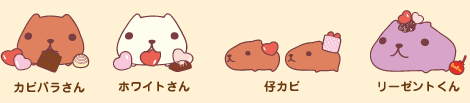
Capybara-san Kyurutto Shop: Capybara is quite a loved animal in Japan (not as a pet, just seeing them in a zoo). It's name uses a character with the meaning of "healing" because of its relaxed characteristics. This shop carries the character items of Capybara and the concept is natural, it says. Here's Capybara-san. Ha ha, I just saw it for the first time, I love it. Kawaii~~ Iyasareru~~ (So cute and healing).... I love the ones in the hot springs. "Healing characteristics" is called "iyashi-chara", Japanese people love this type of healing.

Rerakkuma Shop. Rirakkuma is a made-up word that combines relax and kuma (bear). The bear character is relaxing. I think this character is sold in the US by Sanrio.

Pricure Pritty Store: I may not be right with the spelling. If you know the right one, please let us know.

Hello Kitty Shop: This is another character quite popular in Japan and becoming a hit in the US.

Miffy Style: Miffy is Dick Bruna's rabbit's shop.

K-spot: It's a showcase of new characters and items on trend. The producer is Kiddy Land, a big toy retail store.

Thursday, February 16, 2012

About Omiyage, or Souvenirs (Part 1 of 2)

お土産 Omiyage is commonly translated to the word "souvenir", which we all know are things you buy during your travels and bring home with you. They can be for yourself or to give your friends and family. In Japan, if you happen to work at an office, it is standard practice to buy souvenir chocolates or other sweets and take them to the office as a gift for coworkers, to thank them for their help while you were away on a business trip or for vacation.

You might want something special if you visit Japan but, among Japanese, these are their favorites.

携帯ストラップ Keitai Strap (Cell Phone Strap)

Japanese love collecting tiny things; the art of Netsuke has been known for years. Instead of Netsuke attached to a wallet, the trend is now to attach straps and /or decorative items to a cell phone -- there is a large market in Japan for these straps. (Note: "strap" can mean an actual strap you slip your hand through, or a toy or trinket.) Japanese call cell phones "keitai denwa (portable phone)". The word "phone"is dropped. So in everyday life your Keitei is your cell phone. Keitai straps, according to my observation, should be one of the top items for a souvenir.

In the photo above, Kitty-chan (known as "Hello Kitty" in the US) is holding the Sky Tree. A strap that is designed so that Kitty is attached to some local item is "ご当地キティ Gotochi Kitty". Gotochi refers to a pertinent area of interest so it implies "local". The words of "Gotochi ______" mean a local item. For example, "Gotochi gourmet" means what the visitors want to eat during their trip. "Gotochi straps" are favorite souvenir items to collect or give as a gift for friends and family. Gotochi Kitty-chan straps are quite highly collected items and there are so many different kinds. You'll find at least a couple of them in shops inside the airports and stations or the gift shops in the tourist attractions. Of course Kitty is not the only one. There are so many different characters attached to the local representing items. Quite a few areas have their own characters. And like the image above "Hatsune Miku Kitty-chan", there are items not related to the local area but are special and usually depicting a popular character.

Actually these are an evolved version of old days' key chains. You'll also see a variety of old fashioned Gotochi key chains (Japanese call this a "kii horudaa (key holder)"). Keitai straps are a really favorite souvenir item all over in Japan. These little items are not expensive and usually small, so they are an ideal souvenir of Japan.

Sweets

Local original sweets are also a favorite Japanese souvenir. Often they are neatly packaged individually, which make them handy to give to coworkers as well as to eat by yourself or with your family and friends.

Here are the top Tokyo souvenir sweets you can buy inside Tokyo Station and at Narita and Haneda airports. Note: I'm not a sweet eater so most of them I've never eaten. Sorry, I can't give you a good review.

銘菓ひよこ Meika Hiyoko

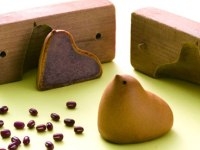
Hiyoko means chicks, the "Meika (famous sweet) Hiyoko" or simply "Hiyoko" is a long time Tokyo souvenir sweet.
A similar item is raccoons, ぽんぽこたぬき Ponpoko Tanuki is more known by me. Both are sold in Narita and Haneda airports. They are sweet bean based, so they may not be too popular for Western tastes, but Japanese love these. You'll find quite a variety of similar sweets which are made with sweet beans and shaped like animals or flowers; they can be purchased all over Japan. This actually originated in Fukuoka in Kyushu, but is known as a Tokyo sweet since the Tokyo Olympics in 1964 when the company started selling them in Tokyo.

ショコラヴィヨン Chocolat Vion

Actually I don't know how to spell this item. These are chocolate covered cookies from Shiseido Parlor. Shiseido is a known cosmetic producer but they originally was a drugstore. In the drugstore there would be a soda fountain, named Shiseido Parlor. So the descendent of this business still remains. You can find a luxurious cafe in the headquarters building as well as in a few branches. The shop part of the business sell them. The original location is in Ginza.

舟和いも羊羹 Funawa Imo Yokan

This is a Japanese version of a sweet potato delicacy. It's made of sweet potato, a long time souvenir sweet of Asakusa. Yokan is a molded square shaped bar, usually made of sweet beans but this is made of sweet potatoes. This is not sold in Narita.

東京ばな奈 Tokyo Banana

It seems to be the best known Tokyo souvenir sweet; everyone knows about it but I wasn't familiar with this treat for a long time, so I think this may be more of a recent favorite. The official website celebrates their 20th anniversary. It's a butter cake with a banana flavored cream filling. I've never tried this so I have no idea what it tastes like. But I would guess that most Westerners will like it. The manufacturer's headquarters is in the Suginami Ward of Tokyo.

東京スマイルマカロン Tokyo Smile Macarons

Macarons are pretty popular sweets in Japan in recent years. I have no idea what these taste like. If you're curious see the linked wikipedia explanation to figure out what it is. I just liked the smilie guy with the colorful pieces -- they are sold in Haneda Airport. It seems they do not have a shop in Narita and I'm not sure the shop in Tokyo Station sells the ones with smiles and hearts. The main shop is in Ginza. They have many shops all over in Japan. Pictured are the Tokyo Smile Macarons.

Here's another heart shaped Macarons from サマンサタバサ Samantha Thavasa. This is a high fashion apparel brand that mainly sells bags and jewelry. They have a shop in Haneda and sell sweets and serve cafe items inside the shop. I believe it is a Japanese business but this website shows a lot of advertising photos with the Western models. It looks odd but it is pretty common to see the Western models in Japanese publications and TV commercials, although they have no relation to the foreigners nor any foreign language information availability.

All of the above items are from Tokyo. Please send us a request and we can furnish information on souvenirs from a particular locale in Japan that you're interested in.